

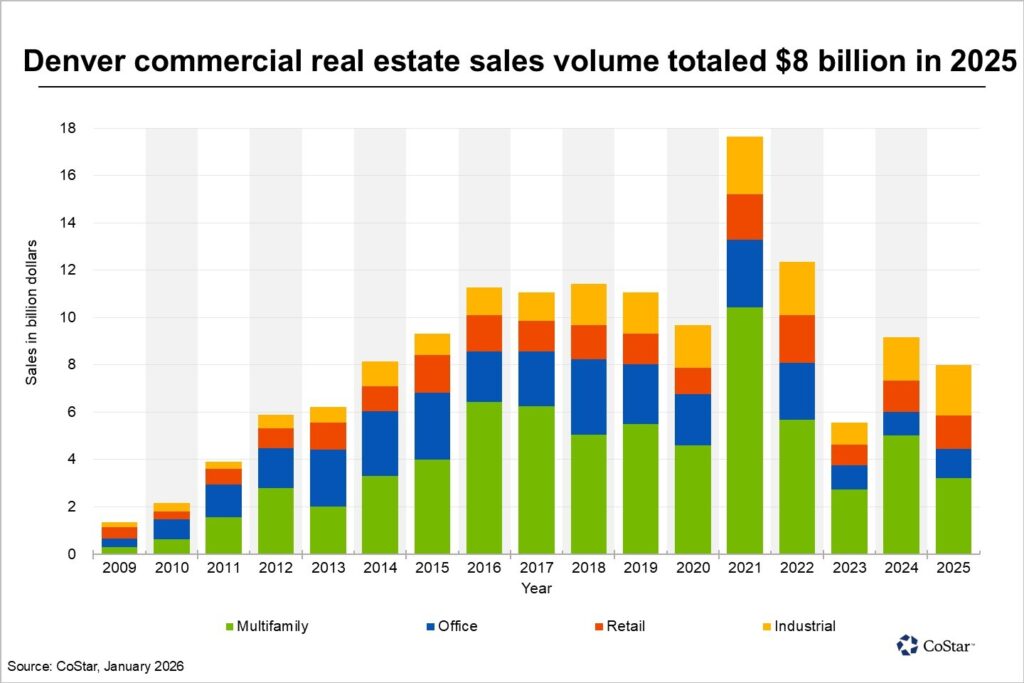
Denver’s commercial real estate market recorded an annual decline in total investment volume in 2025, driven by a sharp drop in multifamily sales. However, an increase in office, retail and industrial deals helped offset some of the losses.
Total sales volume across the four major commercial property sectors — office, multifamily, industrial and retail — totaled slightly over $8 billion in 2025, according to CoStar data. That is down from the $9.2 billion that traded in 2024 and a far cry from the $17.6 billion that sold in 2021.
Multifamily
Multifamily sales totaled $3.2 billion in 2025, a significant decline from the $5 billion sold in 2024 and a fraction of the frenzied sales pace in 2021, when over $10.4 billion traded hands.
The market’s overall volume is typically driven by multifamily sales, which have accounted for an average of 50% of total annual volume over the past decade. But the sector lost significant ground in 2025, making up 40% of total sales volume. That represented the lowest share of volume dating back to 2011.
Denver’s multifamily construction wave continues to pummel the market. Vacancies remain near record highs, dragging down rent growth as landlords face increased competition for renters. While demand is projected to outpace new supply in the year ahead, investors have taken a cautious approach as Denver’s multifamily market remains challenged.
Office
The office sector remained the least liquid in Denver in 2025, with investment volume totaling roughly $1.2 billion. However, activity is up from the $1 billion that traded in 2023 and again in 2024.
Property owners, particularly those facing maturing loan deadlines or mounting expenses, are offloading underperforming properties amid record-high vacancies. While this has resulted in a wave of closed deals, assets are often trading at a fraction of earlier valuations.
Brookfield Properties, for example, sold the Johns Manville Plaza complex downtown for less than $57.5 million, a staggering 85% discount from the $400 million it paid in early 2020.
Similarly, The Hub, located in the city’s RiNo district, has changed hands multiple times since its completion in 2020. Tourmaline Capital Partners acquired the property for $33 million after its previous owners surrendered it to the lender, marking a sizable dip from the $40.5 million paid in 2021.
Investors like Tourmaline are betting on a future recovery, even as office valuations continue to fall.
Retail
Retail sales reached $1.4 billion in 2025, maintaining a stable market presence. In the current high-interest-rate environment, the buyer pool has shifted predominantly to small private investors who target single-tenant, net-leased deals valued under $5 million. These buyers frequently pay all cash to take advantage of 1031 tax-deferred exchanges, making them less reliant on the debt markets than large institutional buyers and real estate investment trusts.
The number of deals closing above $5 million was limited, with the largest deals in the past year focusing on value-add plays with higher capitalization rates, or rates of return, owing to the heightened risk in this tier as well as the more management-intensive nature of these properties.
For example, the 1980s-built Marston Park Plaza in Littleton sold in June for $17.9 million, or $198 per square foot, to Ziff Real Estate Partners. The property was 88% leased at the time of sale to 18 tenants, providing the buyer with a stable cash-flow investment that could also be improved in ways that would add value over a longer holding period.
Industrial
The industrial sector was the second-most active property type, with $2.1 billion in trading volume in 2025. That represented 27% of total investment volume and marked the highest share for the sector in at least 15 years.
Several large warehouse and logistics deals fueled the increase. Among the largest deals was Target’s acquisition of a 530,000-square-foot build-to-suit warehouse in Thornton for $231 million.
Denver commercial sales remain below peak levels seen in the early years of the pandemic. Investor sentiment remains cautious, and deal flow in 2026 may hinge on improving fundamentals across asset classes.